
Making a Case for Workplace Candor
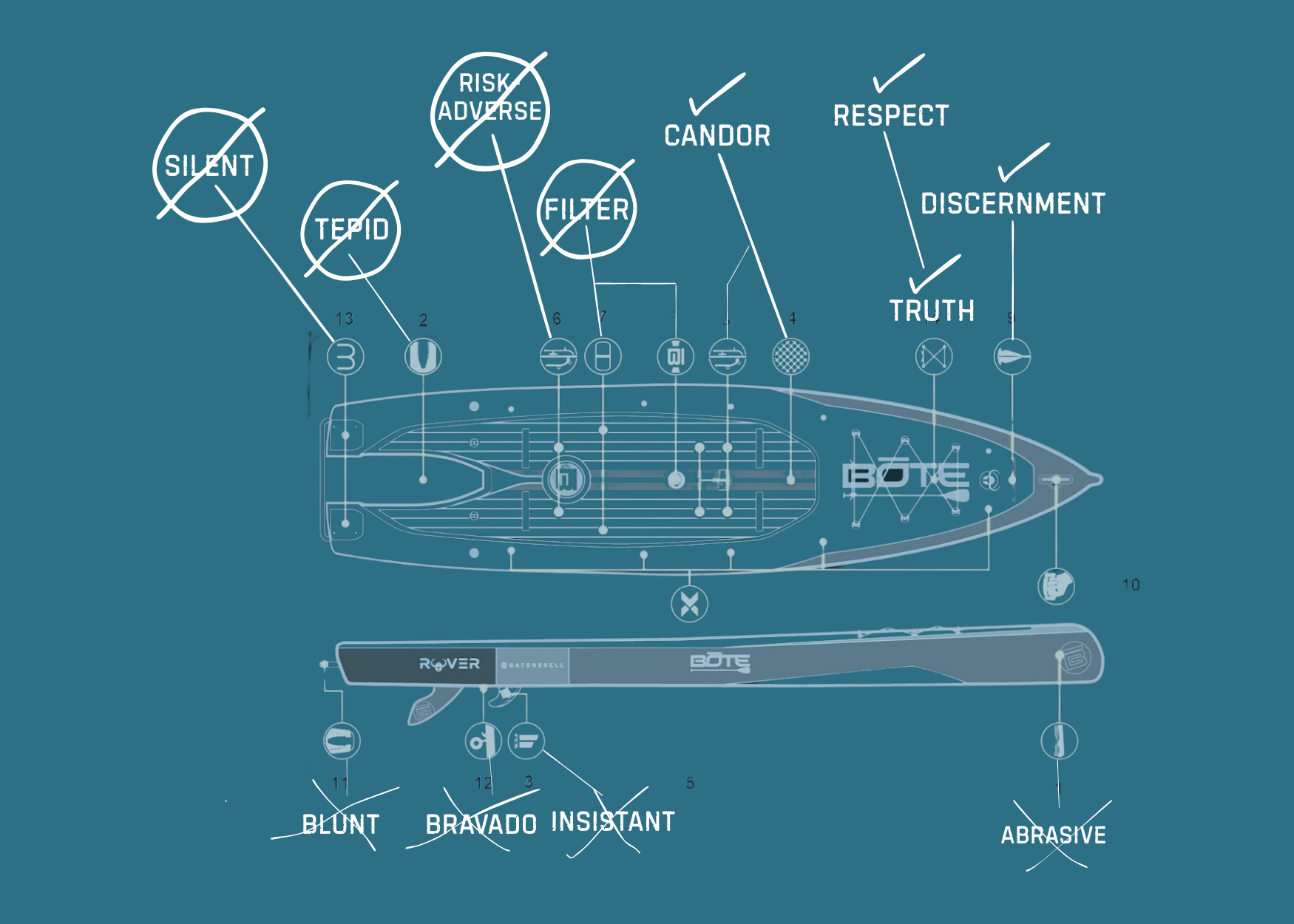
Why a beginner’s behavior on a paddleboard is a useful way to think about workplace tepidness, risk aversion and a failure to pursue candor in family enterprises.
By Amy Hatfield
If you’ve ever observed a beginner on a paddleboard, there’s a tepidness in movement that’s hard to watch. The beginner most often looks like he’s trying not to do something rather than trying to actually do something — crouched down, knees bent, unsteady and unsure. It’s a strain. Just fall in already.
Except they don’t. The beginner paddles carefully, with noodle arms that don’t slice the water. So the paddleboarder avoids the fall. But what good is that? Success, in this case, is defined by staying on the board, dry and useless, making an unproductive turn at covering very little distance.
This assessment is harsh, perhaps, but it’s meant to celebrate the opposite approach: Fall in, get wet, put it all out there, resolute and self-assured.
You might recognize a version of the paddleboarder’s careful tepidness in the workplace. Restraint in how we communicate is often misunderstood as professionalism or deference. Anyone familiar with blue-collar work and workplace culture a generation or two ago has seen the opposite of professional restraint: a good cussing, wrenches thrown, checks docked and people fired and rehired on a regular basis. This approach was chaotic and unproductive, but in many workplace environments today, we seem to have overcorrected.
A lack of candor can lead to unproductive conversations and ill-informed decision making. Too often, our office demeanor is one of two things: 1) careful and tepid; or 2) abrasive and cynical.
There is, in fact, another way. It’s the art of packaging the sharp edges of candor in the bubble wrap of respect.
Hedging Leads to Uninformed Decision-Making
It’s worth slowing down here and being precise about what’s actually happening. These “careful” behaviors are not random, and they aren’t the result of individual incompetence or lack of courage. They are patterns — learned, reinforced and often rewarded — shaped by how modern workplaces respond to risk, disagreement and visibility.
Recast this within a family enterprise where, for instance, your boss is also your father; and your co-worker is, say, your brother, and the stakes become much higher. In family-business settings the risks are greater, and the disagreements reverberate across both personal and professional relationships, where the temptation to avoid these conflicts is multiplied.
Professional risk‑avoidance shows up as careful language, partial disagreement, delayed feedback and decisions that feel engineered to prevent fallout rather than produce clarity. People hedge. They soften conclusions and speak in abstractions instead of specifics. The goal is usually not deception. It’s self‑protection. Avoid being wrong. Avoid embarrassment. Avoid unpopular positions. Avoid consequences.
Related: “Married Ins” — The Royal Family In All of Us
The alternative? For many, it’s a wild swing in the opposite direction: bluntness that borders on hostility. If careful silence is one pole, abrasive veracity becomes the other.
Yet, the problem is not that people are too cautious or too sharp‑tongued. The problem is that the available options for speaking honestly feel artificially narrow. If those are perceived as the only choices, most will continue to default to the safer of the two: careful silence. The result is a slow erosion of clarity and a compromised flow of information.
Conversely, decision-making improves when all cards are on the table.
Expressing Relevant Truth Plainly
When we understand informed decision-making is at stake, most agree it’s best to say what you mean and mean what you say.
Back to the paddleboarding analogy. Do the math. If the paddleboarder goes with resolute confidence, cuts through the water, swift and upright, he’ll make up more distance even when factoring in, say, three spills and the time it takes to climb back on the board. That sounds liberating, right? Employees and employers alike are mostly thinking, “yes, please.”
But how do we take the paddleboard analogy and apply it to how we communicate with candor for families in business or within any workplace setting, for that matter? It’s one thing to buy into the fact that candor is helpful, but it’s another thing to put the belief into practice.
First, if our two options — tepid or abrasive — are both unappealing and unproductive, then a desirable middle ground must be defined as something meaningfully different from both. That desirable approach is candor served with a side of respect.
At its core, respectful candor is the practice of expressing relevant truths plainly, in real time, without stripping those truths of context or care. It prioritizes accuracy over comfort, but it also treats the relationship and the shared work as constraints, not obstacles.
Respectful Candor: What’s the Desired Outcome?
When expressing truths plainly, the goal is not to win an exchange or force agreement, but to surface information that allows better decisions to be made. This distinction matters because respectful candor is often confused with politeness on one side and toughness on the other.
Politeness tends to manage impressions. It filters or delays information to preserve harmony. Bluntness tends to prioritize immediacy. It values unfiltered expression regardless of impact.
Respectful candor does neither. It assumes that withholding relevant insight is a failure of responsibility, and that delivering it without regard for consequences is a failure of judgment. It also promotes a healthy pace. While politeness delays progress and bluntness expediates it, candor cuts through the noise, and gets straight to the proverbial meat and potatoes. Acceleration is desirable, but not at speeds that overshoot the mark.
Practically, a few observable behaviors best define respectful candor:
Those who practice respectful candor speak concretely rather than abstractly.
They are sensitive to timing by naming concerns while there is still time for those concerns to matter.
They distinguish between facts, interpretations and preferences instead of collapsing them into a single claim.
When disagreement is necessary, it is framed around the work, not the person.
When uncertainty exists, it is stated rather than disguised.
Respectful candor also requires discernment.
Discernment is about knowing exactly how far you’re willing to give or take on an issue. It’s having clearly defined borders going into a candid exchange. Not every thought is worth voicing, and not every issue deserves the same level of insistence. Choose when to speak, what to escalate and what to let pass based on how these actions serve (or do not serve) the larger purpose. And never let a desire to avoid discomfort direct your discernment. That selectivity is part of the discipline.
Related: The Fairness Trap
Just as falling off the paddleboard will not keep you dry, respectful candor often requires a person to wade in and forgo protective cover. It exposes the speaker to pushback without the protection of vagueness or bravado. In organizations where norms are unclear or trust is thin, the risk is greater.
So while the burden to practice respectful candor rests in the hands of a company’s workforce, this mentality doesn’t develop in a vacuum. It also depends on the culture employers create. How do our founders, leaders and bosses receive the plain truths that are offered?
For leaders and family-enterprise founders:
Respond first by clarifying the substance of what is being said rather than reacting to how it was delivered.
Questionscome before judgments.
Understanding precedes evaluation.
Leaders seeking candor make their reactions legible. Meaning, they do not punish disagreement indirectly through tone, exclusion or later retaliation.
When a viewpoint will not be adopted, leaders who nurture a culture of candor explain why.
When a concern is valid but untimely, they say so with clarity. Over time, this clarity teaches employees that speaking up will not result in arbitrary consequences.
In moments of stress, leaders do not abandon their standards. Employees quickly learn whether respectful candor applies only in calm moments, or whether it holds when stakes are high.
Respectful candor does not eliminate conflict, and it does not guarantee agreement. What it does offer is a way to surface disagreement earlier, with less residue. It also increases the likelihood that information shared improves the work and informs decision-making in ways that greatly benefit the bottom line of any company’s balance sheet and long-term success.
Featured Photo: BOTE / i3 Illustration
What’s Next:
When families are feuding, fairness is always an issue — and usually, it's about more than just money.
When Estate Docs Can’t Answer Your Questions →
Addressing the questions a family business' estate planning and other legal documents leave unanswered.
Where Have All the Assets Gone? →
In some cases, a family’s “things” are now worth more than their family business. And this is where it gets complex.