
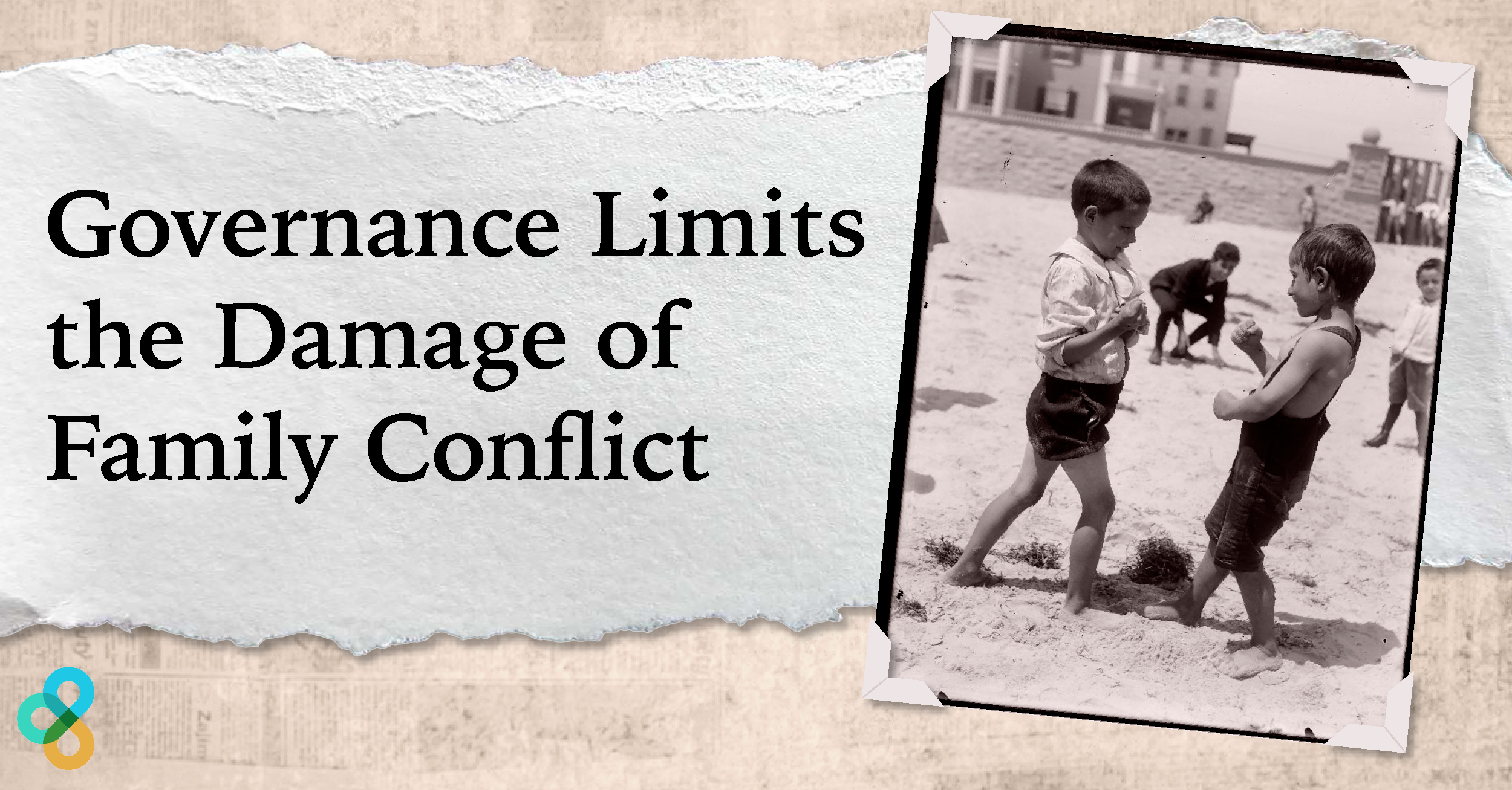
Editor's Note: A version of this article originally appeared as part of our larger piece, "Fracture Points in Family Enterprise: The Real Cause Isn't What You Think." We're republishing this section as a standalone resource because governance remains one of the most effective tools families have for reducing conflict and preserving long-term continuity.
By Amy Hatfield
Human relationships are complex. Every family, regardless of its values, wealth or success, will eventually experience periods of tension. The more useful question is not whether conflict will occur, but whether the family has the structures in place to manage it when it does.
That's where governance comes in.
Understanding the human dynamics beneath conflict helps explain why fractures emerge. Governance and economics determine how much damage those fractures can do.
"There's the control side and the economic side," said Kevin Heaton, founder and principal of i3. "The control side is a family's governance and, of course, the economic side is money, the family's finances. Firms like ours often focus on the financial side. It's easier, cleaner and, especially for people in our industry, it's the area we're trained to address through our educations and professional experiences. But, honestly, you learn quickly, you can't really help families in business unless you help the families themselves by strengthening the relationships these businesses are built on."
Fracture points often intensify where economics and control overlap. Assets carry more than monetary value. They often shape authority, influence and decision-making responsibility. When expectations around those issues are unclear, unevenly understood or quietly contested, friction tends to follow.
Effective governance cannot eliminate the imperfections of human nature. What it can do is provide structure when emotions are running high.
"Well-designed policies and processes reduce confusion and provide steadier footing when pressures rise," Heaton said. "This is where economics and control matter most, not as solutions to human vices, but as guardrails that shape how those imperfections express themselves inside a family enterprise."
Wealth Creates Complexity
As families accumulate wealth, complexity often accumulates alongside it.
Free cash flow frequently finds its way into commercial real estate, farmland, operating companies, private investments and other long-term holdings. Over time, these assets multiply entities, decision points and ownership interests.
Growth is a sign of success. Yet it also introduces new challenges.
Tax planning becomes more complicated. More family members become involved. Expectations expand. Decision-making responsibilities become less obvious. In many cases, governance systems struggle to keep pace with the growth of the enterprise itself.
The result is often a lack of clarity, particularly when communication practices fail to evolve alongside increasing complexity.
Many families experience this most acutely during the transition from Generation 1 to Generation 2. Authority becomes more distributed. Informal assumptions that once worked no longer do.
Questions that once seemed distant suddenly become urgent:
Who decides?
Who benefits?
Who bears responsibility?
What decisions belong to whom?
Without clear answers, uncertainty fills the gap.
Bringing Order to Chaos
When questions are left unanswered, frictions go unchecked.
Families often assume conflict begins with a disagreement. More often, disagreement emerges from an environment where expectations, authority and accountability have never been clearly defined.
A healthy governance framework helps establish the operating rhythm that prevents every challenge from becoming a crisis.
"A family ecosystem does not promise harmony, but it does make room for enough harmony that families can remain intact and effectively address the financial challenges and interpersonal conflict that threaten long-term wealth preservation and growth," Heaton said.
At i3, this ecosystem is built around the interconnected relationship between information, infrastructure and investment. These elements are not independent pillars. They operate as a system, each strengthening the others when designed intentionally.
"Effective governance aligns economics and control in a way that frees families from the strain of improvising under pressure," Heaton said.
When authority is clearly defined and decision rights are understood, families spend less time debating process and more time solving problems. Accountability becomes routine. Decision-making becomes business as usual.
Most importantly, governance reduces the likelihood that business conflict spills into family relationships.
Because while no governance framework can prevent every fracture, it can help keep disagreements from becoming divisions and tensions from becoming estrangements.
And when the damage is limited, families have a much better chance of preserving not only their wealth, but the relationships that made building a family business worthwhile in the first place.
Family conflict is inevitable. Family fractures are not.
The difference often lies in governance, decision rights and the economic systems that support them. In the full article, Kevin Heaton helps us examine how families can recognize fracture points early and build structures that preserve both relationships and wealth across generations.