
Introduction to i3
In this overview, we’ll share information about our company, our view of family enterprise and its history, what creates chaos for families in business and how we help families replace chaos with order — which, in turn, fosters financial and relational harmony.
INSIDE:
^ Who We Are
^ Our Approach > What’s Required
^ i3 Family Ecosystem > How It Works
^ Resources
Who We Are
If we start with “who we are,” then we’re actually starting at the end. This is true because the inception of our company was simply a response, a solution to a larger problem that marks the beginning: The paradoxical nature of mixing business with family and family with business.
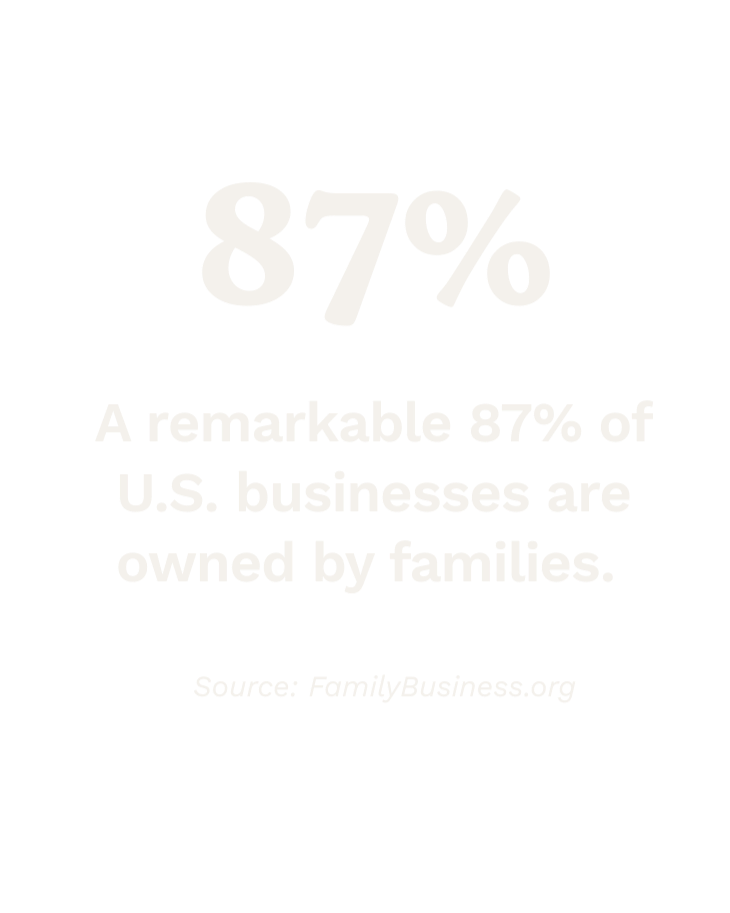
And while it’s also true that the challenges most families in business face are unique, family-owned businesses aren’t unique at all. A remarkable 87% of U.S. businesses are owned by families. When our country was in its infancy, we relied on a single economic engine for the first 100 years: family farms and family-owned small businesses. There was nothing else. In fact, according to former Wall Street Journal editor Christopher Conte, “Americans liked it that way.”
Conte qualified this sweeping observation by citing the words of Thomas Jefferson. America’s third president believed an economy built on independent, family-owned businesses would inoculate Americans against the disease of dependency.
“[Dependency] begets subservience and venality, suffocates the germ of virtue, and prepares fit tools for the designs of ambitions.”
Jefferson did not envision an America where its citizens would be the tools used to harvest the spoils of a bigger man’s ambition. And he believed the germ (or seed) of virtue, born of an independent spirit, must be sown early. Otherwise, it won’t take. And take it did.
Generations later, these same traits — independence, ingenuity, resilience, self-reliance and resourcefulness — remain. They exist in plain sight, within our own client families. We see it in each of them, because we recognize it in ourselves. Family business — we understand it because we were raised on it.
It’s who we are.
All of this matters a great deal. These intangible character traits and baked-in beliefs inform every tangible business decision a family enterprise makes. And the enterprise itself is informed by the individuals who make a family — some converging, some diverging — but all lightly twisted and plied together like twine that binds a single bale of hay. Tight enough to hold the bale intact, but loose enough to fray.
Our Approach
If we boil it down, we can point to two key factors that have propelled our success as a private asset management and family CFO office. One, most successful family enterprises will eventually find themselves at an impasse, which we classify as fractures. That first notable fracture — one significant enough to threaten the life of a company — is nearly inevitable, so the demand is plentiful.
And, two, we believe families are stronger together. Most people like the idea of family and togetherness, but too many don’t take the necessary steps required to keep the family together. Those steps involve two sides of the same coin: financial and relational. To steal a line that’s often attributed to legendary college football coach Bobby Bowden, “It’s not the X’s and O’s, but the Jimmys and the Joes.”
We often say fracture is the catalyst that leads a family to us. But really, the catalyst is actually success, which then causes fracture. While growth signals a job done well, it also introduces increased complexities in a family’s ownership structure. Complexities are driven by generational tax planning, yes, but also the expanding involvement of family members. These dynamics can create significant financial challenges and interpersonal conflicts that threaten long-term wealth preservation, enterprise growth and family cohesion.
Giving proper weight to each of these — the X’s and O’s and the Jimmys and Joes — is a key differentiator of i3.
5 Attributes Required to Become a Generational Family Enterprise
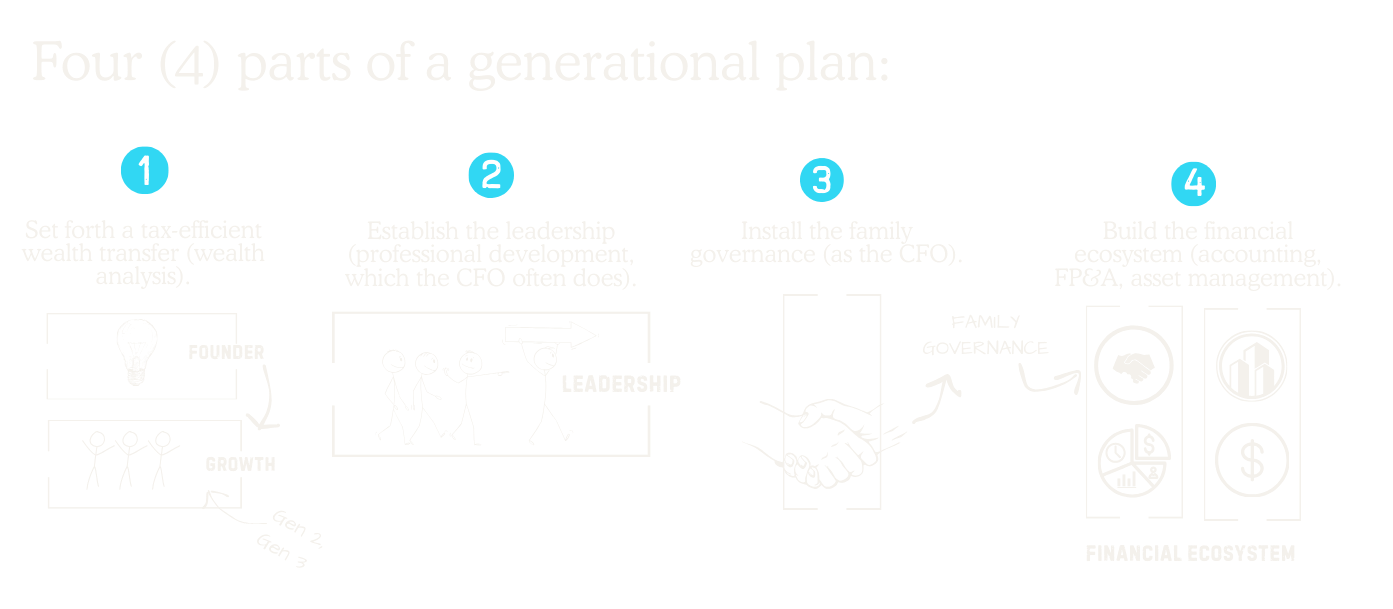
In our nearly 20 years of working with families in business, we’ve observed (5) traits successful families share. You’ll notice the five provide tools required to meet financial challenges, while also arming families with what’s needed to address the inevitable interpersonal conflicts that threaten sustained growth.
They believe families are stronger together, and their behaviors reinforce this belief.
Their behavior is a reflection of these five (5) words: candor, intentionality, integrity, curiosity, grit.
They have intelligent wealth transfer strategies prescribed by tax counsel.
They use well-developed financial ecosystems to bring order to chaos.
They possess clear, family governance frameworks.
Our Family Ecosystem
As family enterprises accumulate wealth, these entities often use their free cash flow to accumulate “filing cabinet” assets such as commercial real estate, undeveloped acreage or hunting properties, business interests and limited partnership investments.
These are examples of the aforementioned growth and subsequent complexities many family enterprises experience, especially as the founder attempts to navigate the transition from Generation 1 to Generation 2. The level of difficulty is high, but we only emphasize this as a point of reassurance. Most families, even as competent and successful as many are, struggle with succession planning. This bears out in the data — only about 30% of U.S. family businesses transitioning successfully to Gen 2, according to Cornell SC Johnson College of Business. Still, these challenges can be mitigated with a well-developed family ecosystem — an infrastructure we help client families develop across four (4) critical areas:
succession planning,
wealth analysis and forecasting,
private asset management,
and financial infrastructure.
By aligning each of the four, families can build resilient, independent systems within an interconnected environment. The result is a family enterprise that optimizes financial performance, ensures seamless generational transitions and fosters enduring family relationships.
How It Works
The i3 Family Ecosystem is a process, or mapping system, if you will, designed to bring order to chaos. We like the word “ecosystem” because it's designed to do the one thing a family enterprise needs above all else: Take independent entities and harmonize each into a single, thriving collective. By its very nature, this setup promises a productive and necessary friction: the push and pull of reconciling what’s good for the individual with what’s good for the whole.
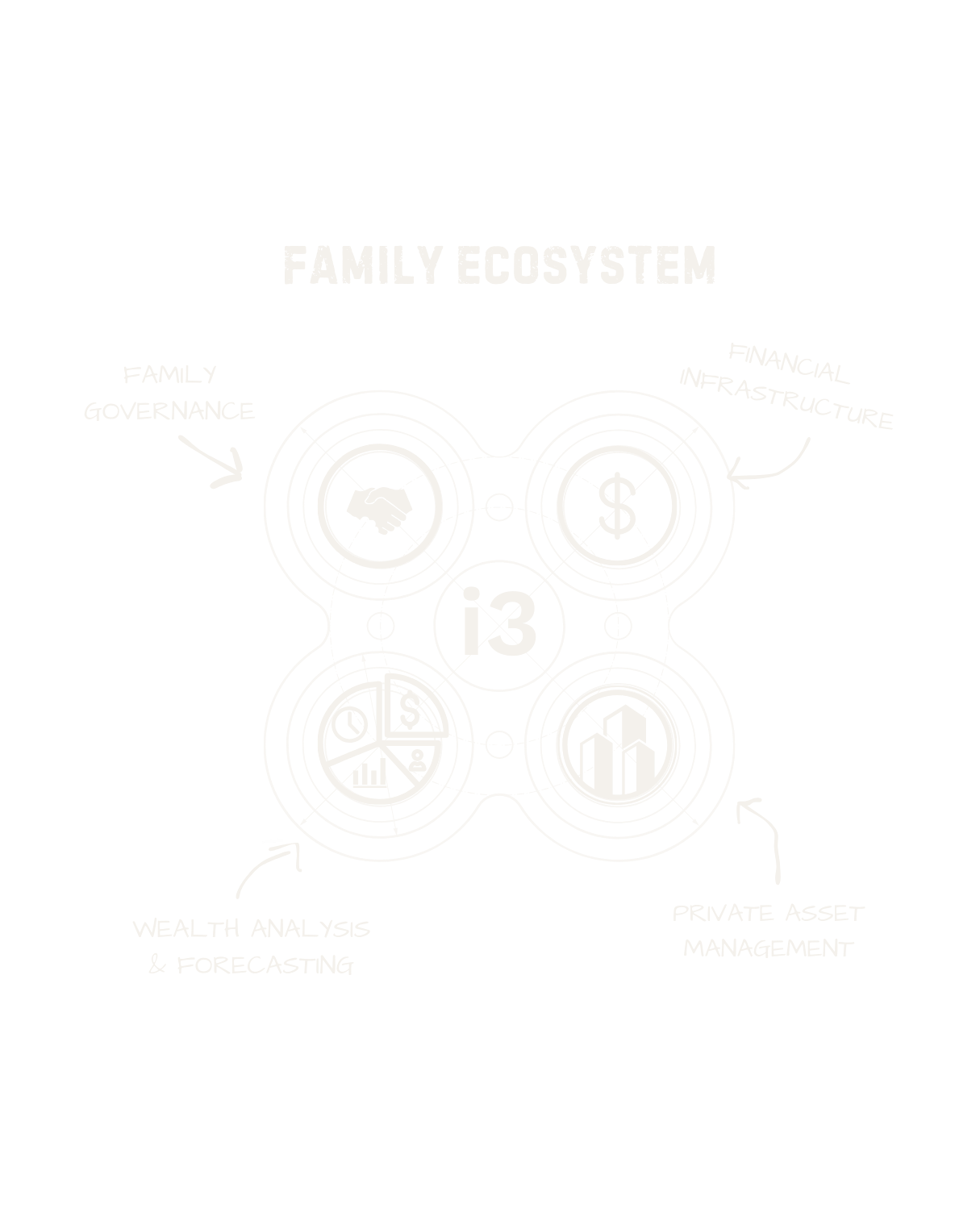
Our ecosystem brings Control (family governance) and Economics (financial planning and analysis, accounting, and — when needed — asset management) into a symbiotic relationship to serve the family enterprise.
On the Control side, the Family Ecosystem makes governance tangible. Instead of abstract principles, families receive a clear map of who has authority, what decisions belong where and how leadership roles cascade across trusts and entities. This culminates into a visual matrix outlining decision rights and accountability that reduces confusion, prevents misalignment and creates a durable operating rhythm.
On the Economic side, the Family Ecosystem turns complexity into usable insight. Our reporting consolidates the family’s financial reality — cash, performance, obligations, forecasts, and distribution planning — into an accessible reporting experience that supports better decisions at the family level. The reporting apparatus is designed around disciplined data flow, standardized modeling, and a consistent view of what matters most for sustaining the family’s objectives.
What makes the Family Ecosystem different is that it’s not just reporting — it’s economic stewardship paired with governance integrity, guided by a CFO lens. Families don’t simply learn “what happened”; they gain a living framework that answers the real questions:
Are operating entities carrying their weight?
If not, what must the family’s assets produce to support lifestyle and obligations?
Are distributions aligned with entity purpose and long‑term preservation?
Where is risk building — financially or behaviorally — and what needs to change before it becomes a problem?
This integrated view ensures that cash movement, distribution policy, and decision authority stay aligned with the family’s desired structure and long‑term plan.
Finally, the Family Ecosystem is designed to be repeatable. It creates a monthly cadence where governance and economics reinforce each other — so families operate with fewer surprises, better communication and greater confidence.
If you’d like to dive deeper into the information shared here or learn how to apply these principles to your own family enterprise, send us a note using our contact page or email us at info@i3resources.com.
Resources
Family Matter
Our Family Matter blog offers commentary and how-tos on navigating the financial and relational complexities of a family enterprise. Some of our most read articles include “The Fairness Trap” and “Wealth Is a Gift, Not an Entitlement.”
Estate Planning: Mechanical vs. Emotional
Who should you call when your estate documents can’t answer your questions?
Where Have All the Assets Gone?
A look at how your family can keep track of your (filing cabinet) assets.
‘Married Ins’
The Royal Family in all of us: How ‘married-ins’ change family dynamics.